

Let’s clear the confusion. Treasury bills and commercial papers might both be short-term investments, but they’re not the same. And understanding that difference is key to making the right move with your money.
Treasury Bills, or T-bills, are short-term debt instruments issued by the Nigerian government. When you buy one, you’re essentially lending money to the government for a fixed period, usually 91, 182, or 364 days.
At the end of that term, you get your money back, plus interest. It’s simple, low-risk, and backed by the Central Bank of Nigeria.
Commercial Papers (CPs), on the other hand, are issued by private or public companies. When you invest in a CP, you’re lending money to a corporate organization, like MTN, Golden Penny Flour Mills, or Dangote for a short period, typically between 90 and 270 days. The company pays you back with interest once the tenure is complete.
The key difference between treasury bills and commercial papers is that T-bills are government-backed while CPs are corporate-backed—so returns are higher, but risk is higher too. Both instruments serve a purpose. The right one for you depends on what you value more: guaranteed safety or potentially better returns.
How Treasury Bills Work: A Low-Risk Way to Preserve Your Capital
If your goal is to protect your money without worrying about market swings or unexpected losses, treasury bills are one of the safest ways to do it.
Here’s how it works: You buy a T-bill at a discount of ₦950,000 instead of ₦1 million, after a set period (91, 182, or 364 days), the government pays you the full ₦1 million. That difference is your return. It’s simple, fixed, and secure.
The returns are modest—typically between 16% and 19% annually, but the real value is in the peace of mind. Since T-bills are backed by the Central Bank and Federal Government, the risk of default is practically zero.
T-bills are locked for the duration you choose. So once you invest, that money stays untouched until the maturity date. While that reduces flexibility, it also protects your capital from impulse spending or market losses. This is perfect for people who want stability over excitement:
- Conservative investors who want a safer option than savings accounts
- Retirees looking for predictable returns
- First-time investors who want to start with something simple and low-risk
For instance, a civil servant who needs to set aside ₦1 million for rent due in six months. Rather than leave it idle, they invest in a 182-day T-bill. At the end of the term, the money is not only intact, but it’s grown slightly without any stress or risk.
This is why it is worthy of note that T-bills won’t make you rich overnight, but they will preserve the value of your money, especially when you just need a reliable place to park it for a few months.
How Commercial Papers Work: Higher Returns, Slightly Higher Risk
Commercial papers are an option that’s gaining serious attention from investors who want more than just preservation. They are short-term debt instruments issued by large, established companies looking to raise quick working capital.
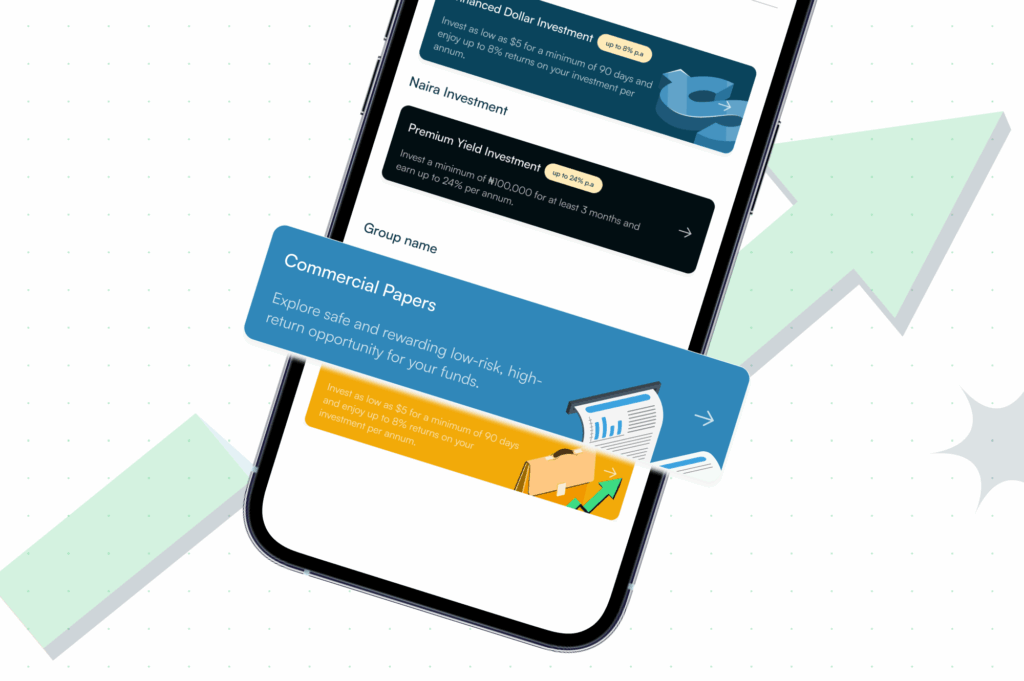
When you invest in a CP, you’re lending money directly to a corporate brand like MTN, Dangote, or Golden Penny Flour Mills, and they pay you back with interest after a fixed period, typically between 90 and 270 days.
Because you’re lending to a company (not the government), returns are usually higher than treasury bills, often in the 22% to 27% annual range. The slight trade-off? More risk.
While CPs are not backed by the government, they’re still regulated by the Securities and Exchange Commission (SEC) and only approved companies with strong credit ratings are allowed to issue them. Like T-bills, your money stays locked in until the maturity date. So this isn’t the right place for emergency funds or money you might need suddenly.
Who’s it for?
- Investors looking to grow capital faster than T-bills can offer
- Savvy savers who understand that more return = slightly more risk
- People with short-term goals and no immediate need for the money
Commercial papers are ideal when you can confidently set money aside for a few months, and you want better returns without going into stock market volatility. If you’re clear on your goal and comfortable with committing funds short-term, CPs strike a strong middle ground: better returns without needing to take wild risks.
Treasury Bill vs Commercial Papers Investment: Which Is Better?

It’s the big question: treasury bill vs commercial paper investment— which is better? The truth is, one isn’t outright better than the other. It all comes down to what you need from your money right now.
Let’s break it down:
Feature | Treasury Bills | Commercial Papers |
Issuer | Government (CBN) | Corporates (e.g., MTN, Dangote) |
Risk Level | Very Low | Low to Moderate |
Return Range | ~16% – 19% annually | ~22% – 27% annually |
Tenure | 91, 182, or 364 days | 90 to 270 days |
Liquidity | Locked until maturity | Locked until maturity |
Ideal For | Capital preservation | Short-term capital growth |
Security | Government-backed | SEC-approved + credit rated |
Considering the comparison above, none is outrightly better than the other but If you want stability, go with Treasury Bills. If you want higher returns and can handle a bit more risk, Commercial Papers are better.
But again, it’s not a battle. It’s a choice based on your situation. For instance,
- You’re saving for rent in four months and can’t afford losses? → Go with T-bills.
- You’re setting aside capital for your small business in six months and want it to grow faster? → CPs may serve you better.
Both options have a place in a smart short-term strategy. What matters is aligning them with your financial timeline and your risk tolerance level.
Sycamore: Invest in Both Without the Stress of Buying Directly
You don’t need to chase banks, fill out forms, or meet huge capital investment minimums (like N50m) just to invest in treasury bills or commercial papers. With Sycamore, the process is digital, seamless, and built around you. We’ve made it simple for you to access both government-backed and corporate-backed investment options; all without the paperwork and gatekeeping that used to slow people down.
Here’s how we help you do it:
- Commercial Paper Investments – Earn between 22% and 27% returns p.a by investing in short-term debt from trusted Nigerian corporates. You choose how long to invest, and we handle the heavy lifting.
- Portfolio Plans With Treasury Bills – Want capital protection and stable growth? Our managed portfolios include treasury bill allocations tailored to your goals.
- Low entry barrier – You don’t need millions to start. With as little as N100k, you can begin investing in the same asset classes once reserved for big institutional investors.
- Fully SEC-licensed and transparent – Every product you access through Sycamore is regulated and professionally managed.
Whether you’re looking to protect your cash or grow it faster, Sycamore gives you access to both T-bills and CPs—no middlemen, no confusion. All you have to do is choose your goal. We help you get there.
Click here to fill a quick form and get started on your investing journey.
Which One Are Nigerians Choosing More in 2025?
Not long ago, treasury bills were the default. Banks pushed them. People trusted only them. And for a time, it seemed like they were the only investment type that worked. But in 2025, that’s no longer the full story.
More Nigerians are turning to commercial papers, most especially through platforms like Sycamore. And the reasons are:
- The returns are clearly better than what treasury bills offer.
- The process is now simpler, with platforms removing the old friction of brokers, forms, and minimums.
- The companies behind CPs are familiar brands, which gives investors more confidence.
For instance, Feyisayo, a small business owner in Lagos saved ₦2 million over six months using Sycamore’s commercial paper investment. By the end of the term, her return was multiples of what she would’ve earned through traditional bank fixed deposits. And the investment setup was so simple and straightforward. Therefore, It’s not just about yield. Access, clarity, and control are equally, if not more, important. Nigerians are realizing that they no longer have to settle for slow growth when smarter options exist.
Mistakes to Avoid When Investing in Either
T-bills and commercial papers are great tools—but even the best investment can go sideways if you walk in blind. Before you commit your money, here are some mistakes you absolutely want to avoid.
Mistake 1: Investing in commercial papers without checking the issuer. Not all companies are created equal. If you can’t verify the company’s credit rating or reputation, and the platform won’t tell you, endeavour not to invest.
Mistake 2: Using locked investments for money you’ll need soon. Once your funds are in, you can’t pull them out early. So if you’ll need the money next month, neither T-bills nor CPs are the right place for it.
Mistake 3: Falling for high returns without licensing proof. If a platform promises wild returns but doesn’t clearly show its SEC license, that’s a red flag. Sycamore is licensed and regulated by SEC, you should never settle for less.
Mistake 4: Thinking lower returns are bad by default. Sometimes, the smartest move is preserving your capital, not chasing higher yields. Your strategy should match your goal, and not someone else’s hype.
Therefore, It’s not just about return but about reliability, clarity, and timing. Avoid these traps, and you’ll position yourself to invest confidently, not emotionally.
Getting Started: How to Invest in T-Bills or CPs with Sycamore Today
With Sycamore, the steps are fast, digital, and built to work for you; not against you. Investing in Treasury Bills and Commercial Papers with Sycamore Investment Management Limited (SIML) involves a simple, guided process:
- Step 1: Fill a short Investor Form– You are required to fill out and submit the Know Your Customer (KYC) form provided by SIML. This step ensures compliance with regulatory standards and validates investor identity.
- Step 2: Professional assistance: An investment advisor from the team will reach out to you to guide you on the next steps.
- Step 3: Choose Investment Option
With proper professional guidance, you can now choose the option you prefer; whether Commercial Papers of Treasury Bills.
Treasury Bills: If the investor prefers Treasury Bills (T-Bills), the primary market (Nigerian Treasury Bill auction) option requires a minimum of ₦50.001 million. However, those looking to start smaller can invest through the secondary market, where the minimum investment is ₦1 million.
Whether you want the stability of T-bills or the stronger growth potential of CPs, Sycamore makes both accessible, with clear terms and real returns. Start small, grow steadily, and make your money work smarter.
Final Take: There’s No “Best” Option Only the Right Fit for You
Don’t let jargon or fear keep you stuck. Treasury bills and commercial papers both have their place. You just need to match them to your goals.
If you value stability and capital preservation, treasury bills are solid. If you want higher returns and can stay committed for a few months, commercial papers are the smarter play.
With a platform like Sycamore, you don’t have to figure it out alone. We’ve made it easy to start small, stay informed, and build confidence while your money grows.
Click here to fill a quick form and get started on your investing journey.